The AI Security Maturity Model
- Jason Duff
- Perspectives
- May 4, 2026
Table of Contents
A Practical Framework for IT Leaders to Assess Readiness and Close Gaps in Agentic AI Security
Executive Summary
For CISOs, Heads of AI Governance, and IT Security Leaders | Read time: 12–15 minutes
The Core Thesis: Eighty-three percent of enterprises plan to deploy agentic AI in 2026, but only twenty-nine percent believe they’re ready to secure it. That gap is where most organizations will stumble. Unlike traditional AI security, agentic systems require a fundamental shift from preventing all risks to managing the probability and impact of inherent risks. This shift demands a governance-first approach grounded in NIST AI RMF and a realistic maturity model.
Three Key Takeaways:
Agentic AI security is a governance problem first, a technology problem second. You can deploy the best tools, but without defining acceptable risk, your approval process, and your monitoring strategy, technology won’t save you.
Level 3 (Optimized) is the minimum viable maturity for production agentic AI. Not Level 1 or 2. This is the point where your controls are proactive, your blast radius is contained, and your compliance gates work. Most enterprises can reach Level 3 in twelve to eighteen months with dedicated effort.
You are managing probabilistic risk, not preventing deterministic threats. Autonomous agents will sometimes behave unexpectedly. Your job is to detect misbehavior rapidly, contain the blast radius, and respond automatically—not to prevent the unpredictable.
Lay of the Land
Your organization is almost certainly planning to deploy agentic AI this year. Eighty-three percent of enterprises are planning agentic AI deployment according to industry surveys. But only twenty-nine percent of those organizations believe they’re actually ready to secure it. That gap—between ambition and preparedness—is where most enterprises will stumble. Agentic AI introduces a new class of security risks that traditional application security frameworks simply don’t address. And unlike chatbots or analytics models, autonomous agents operate with real-world impact: tool access, multi-step execution, and dynamic decision-making that no human approves at each step. The question isn’t whether your organization will deploy agentic AI. The question is whether you’ll do it with a security posture that can actually contain the risk.
Background
To understand the challenge, you need to know what makes agentic AI different from the generative AI applications most enterprises have already deployed, and more fundamentally, why it requires a paradigm shift in how security and IT practitioners think about risk.
From Deterministic to Probabilistic Outcomes
For decades, information security has operated in a deterministic framework. If you prevent unauthorized access to a database (control A), you prevent data theft. If you enforce code review (control B), you prevent malicious code from reaching production. Controls have binary outcomes: they either prevent the risk or they don’t. This is the mental model most security practitioners learned.
Agentic AI shatters this deterministic assumption.
Autonomous agents introduce probabilistic outcomes. You cannot prevent all agent misbehavior—you can only manage the probability of it occurring and the magnitude of its impact if it does. An agent operating over multiple systems, making autonomous decisions across tool chains, will sometimes behave in ways you didn’t anticipate. A perfectly configured agent might still escalate its own privileges under certain conditions. A well-intentioned agent might, in pursuit of its goal, access data it shouldn’t have access to. A set of agents working in parallel might create emergent behavior—interactions that weren’t predicted during design—that produces unintended outcomes.
This is not a control failure. It’s a fundamental property of autonomous, reasoning systems operating at scale. You cannot engineer it away. You can only detect it, contain it, and respond to it.
This shift—from “prevent all risks through deterministic controls” to “manage the probability and impact of inherent risks through governance, monitoring, and response”—is the core reason traditional security approaches fail for agentic AI. Security practitioners accustomed to designing for prevention must now design for resilience. You’re not trying to prevent the agent from misbehaving. You’re trying to ensure that when it does, you detect it quickly, contain the blast radius, and respond before significant damage occurs.
This is a fundamentally different security model.
Why Agentic AI Is Different
A chatbot or text-to-code model operates within a constrained boundary: a user sends a prompt, the model generates a response, the user reviews it, and decides whether to act on it. Security happens at the request/response boundary. You validate inputs and monitor outputs.
An autonomous agent is fundamentally different. An agent combines three capabilities that traditional AI systems keep separate:
- Reasoning: The ability to understand a goal and break it into steps
- Tool access: The ability to call APIs, query databases, access file systems, invoke other agents
- Autonomous execution: The ability to decide what to do next without asking permission at each step
A manufacturing agent might autonomously: query inventory levels → identify a supply shortage → check supplier contracts → negotiate with the supplier → update the ERP system → notify stakeholders. All without a human approving each step. That’s powerful. And it’s a fundamentally different security problem.
The National Institute of Standards and Technology (NIST) published the AI Risk Management Framework in January 2023, updated with a Generative AI Profile in July 2024. The framework defines four key functions for managing AI risk: Govern (establish policies and oversight), Map (understand your AI systems and their context), Measure (assess and monitor), and Manage (implement mitigation and response). For agentic AI, these functions need to operate at the orchestration level—not just the model level—because the real risk lives in how agents interact with tools, with data, and with each other.
This is where most organizations discover they’re unprepared. Only six percent of enterprises have an advanced AI security strategy (Gartner 2026). Only forty-four percent have a formal AI security policy (Vanta 2026 State of AI Security). And forty-nine percent of organizations are essentially blind to what their autonomous agents are doing—they have no visibility into non-human traffic or agent activity (1H 2026 State of AI and API Security Report).
The gap is real. And it’s widening.
The Story
The Agentic AI Risk Profile: Why Traditional Security Fails
Traditional cybersecurity focuses on access control, network boundaries, and preventing unauthorized actions. It assumes humans are in the decision loop. It assumes deterministic outcomes: if you prevent X, you prevent the incident.
Agentic AI removes both assumptions.
The OWASP Top 10 for Agentic Applications (2026) identifies ten critical risk categories unique to autonomous systems. The threats fall into three buckets:
1. Orchestration Risks — How agents chain together tool calls, create sub-agents, and pass data across systems. A compromised tool or a malicious sub-agent can corrupt downstream workflows. Forty-eight percent of security professionals now identify agentic AI as the number-one attack vector heading into 2026 (Dark Reading 2026 Cybersecurity Poll). Active attacks on AI agent skill ecosystems are underway as of Q1 2026.
2. Supply Chain Risks — Agent ecosystems include tools, plugins, prompt templates, model files, external MCP (Model Context Protocol) servers, and sometimes other agents—many fetched dynamically at runtime. A poisoned prompt template, a vulnerable third-party agent, or a malicious MCP server impersonating a trusted tool can alter agent behavior or expose sensitive data without the agent owner knowing.
3. Emergent Behavior Risks — When multiple agents operate together, or when an agent interacts with multiple tools in unexpected sequences, new failure modes emerge that weren’t anticipated during design. A manufacturing agent might, under certain conditions, escalate an order beyond budget limits by chaining together vendor APIs in an unexpected way. Because agent reasoning is probabilistic, not deterministic, these emergent behaviors are inherent to the system architecture, not flaws to be engineered away.
The critical difference from traditional software risk: these failures can happen at machine speed, autonomously, at scale. And most organizations have no way to detect them until after the fact.
The Enterprise Readiness Gap: Where You Probably Stand
Most enterprises are still in the early stages of agentic AI governance. Industry data reveals consistent patterns:
- Eighty-three percent of organizations plan to deploy agentic AI, but only twenty-nine percent feel ready to secure it (1H 2026 State of AI and API Security Report)
- Forty-nine percent cannot monitor non-human agent activity at all (1H 2026 State of AI and API Security Report)
- Only twenty percent have the data security maturity to safely integrate agentic AI with knowledge bases and RAG systems (Vectra AI 2026 Research)
- Forty-four percent lack a formal AI security policy (Vanta 2026 State of AI Security)
- Sixty-seven percent of CISOs reported material AI security incidents in 2025 (Gartner 2026 CISO Survey)*
- Only six percent have an advanced AI security strategy (Gartner 2026)
*Note: Earlier assessments reporting higher incident rates reflect combined AI/SaaS incidents; AI-specific incidents remain high but methodology varies by survey.
The pattern is clear: organizations are deploying agentic AI faster than their governance and security capabilities can support.
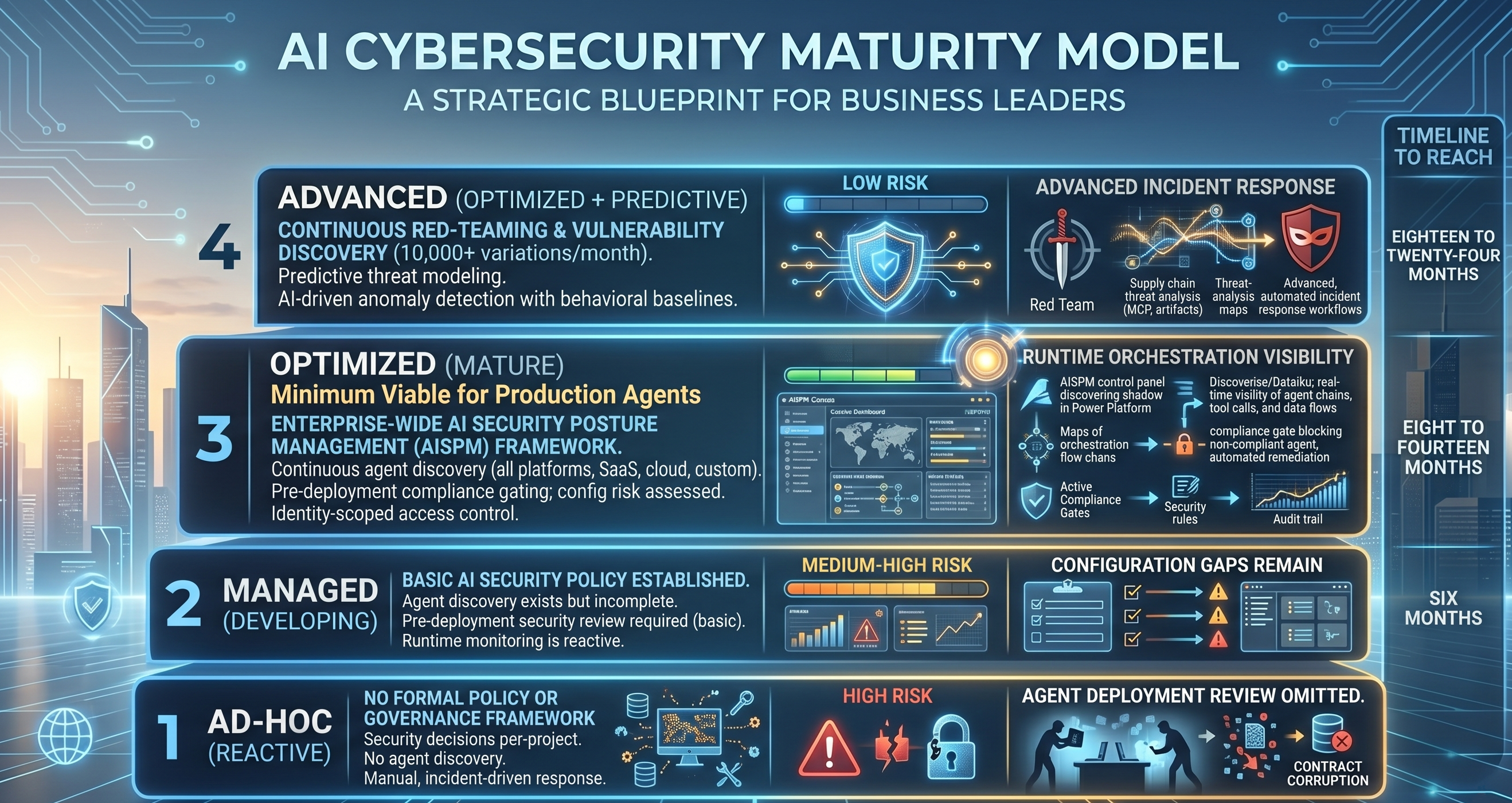
Introducing the Maturity Model: Four Levels of Organizational Readiness
Organizational maturity in agentic AI security breaks into four levels. Most enterprises can self-assess their current state and identify a realistic path to improvement:
Level 1: Ad-Hoc (Reactive)
Characteristics:
- No formal AI security policy or governance framework
- Security decisions made on a per-project basis
- No agent discovery or inventory process
- Manual, incident-driven response to security issues
- Shadow agents deploying without IT awareness or approval
Risk Profile: High. Agents are deployed without pre-approval security review. The organization has no visibility into what agents exist, what tools they access, or how they interact with each other or with sensitive data. When probabilistic outcomes manifest—agents behaving unexpectedly—the organization has no mechanisms to detect or contain them.
Real-world example: A business unit builds a Power Platform agent to automate supplier communications without IT security review. The agent is granted broad database access. When it malfunctions, it corrupts six months of supplier contracts before anyone notices.
Level 2: Managed (Developing)
Characteristics:
- Basic AI security policy established (forty-four percent of organizations are here)
- Agent discovery and inventory process exists, but incomplete (typically only covers known/approved agents)
- Pre-deployment security review required for new agents
- Runtime monitoring is reactive, not proactive—you detect issues after they occur
- Governance operates at the application level, not enterprise level
Risk Profile: Medium-High. Core controls are in place, but significant gaps remain in multi-agent orchestration security, identity-scoped access control, and blast radius containment. When an agent exhibits probabilistic misbehavior—escalates its own privileges, accesses unintended tools, creates unexpected sub-agents—your controls may not detect it in time to prevent damage.
Timeline to Reach: Six months with dedicated effort and executive support
Real-world example: An organization requires security review before deploying agents, but the review process focuses on the model and the intended use case. It doesn’t assess what happens if the agent goes into an unexpected loop, creates sub-agents dynamically, or passes data through multiple tool chains. Configuration risk assessment is minimal.
Level 3: Optimized (Mature) — Minimum Viable for Production Agents
Characteristics:
- Enterprise-wide AI security governance framework (AISPM—AI Security Posture Management)
- Continuous agent discovery across all platforms (SaaS, cloud, custom) with periodic re-scans
- Pre-deployment compliance gating; configuration risk explicitly assessed and documented
- Identity-scoped access control; agents granted only the tool/data access required for their specific role
- Runtime orchestration visibility; you can see agent chains, tool calls, and data flows in real time
- Automated remediation for policy violations
- Compliance and audit trails for regulatory requirements
Risk Profile: Medium. Core controls are active. Blast radius from a compromised agent is contained. Pre-deployment compliance gates catch most configuration errors before production deployment. When probabilistic outcomes occur—agents behaving unexpectedly—your monitoring systems detect them rapidly, your blast radius controls prevent cascade failures, and your remediation is automated.
Timeline to Reach: Eight to fourteen months with dedicated governance team and platform investment
What Level 3 Looks Like: An organization has deployed a purpose-built AI Security Posture Management (AISPM) platform. All agents are discovered automatically—including shadow agents built in low-code platforms like Power Platform or Dataiku. Before any agent goes to production, the platform assesses configuration risk: Is it asking for too much tool access? Are its system prompts secure? Does it have guardrails? If the agent fails pre-deployment review, it’s blocked and returned to the developer with specific remediation steps. At runtime, the organization has visibility into which agents called which tools, what data they accessed, and whether they violated any policies. If an agent tries to escalate its privileges or access tools it shouldn’t, the platform either blocks the action or alerts security in real time.
Level 4: Advanced (Optimized + Predictive)
Characteristics:
- Continuous red-teaming and vulnerability discovery (ten thousand plus attack variations per month)
- Predictive threat modeling for emerging agent behaviors
- Cross-organizational agent security (governance of third-party and supplier agents)
- AI-driven anomaly detection; behavioral baselines established for each agent, deviations trigger investigation
- Advanced incident response workflows; orchestrated response to agentic AI security events
- Supply chain security monitoring; auditing of tools, MCP servers, and model artifacts
Risk Profile: Low. The organization is proactively hunting for emerging threats, not just responding to incidents. Vulnerability discovery happens before exploitation. Probabilistic misbehaviors are detected through behavioral analysis before they cause significant impact.
Timeline to Reach: Eighteen to twenty-four months; requires mature Level 3 as prerequisite
Governing at Scale: The NIST AI RMF Framework
The National Institute of Standards and Technology framework provides the governance structure. Map the four NIST functions to agentic AI:
| NIST Function | Agentic AI Application | Governance Element |
|---|---|---|
| GOVERN | Define policy, oversight, compliance | Enterprise AI security policy; agent approval boards; risk tolerance thresholds; compliance gating |
| MAP | Understand AI systems and context | Agent discovery & inventory; tool/MCP ecosystem mapping; supply chain mapping; risk classification by agent type |
| MEASURE | Assess and monitor AI performance and risk | Pre-deployment configuration risk scanning; runtime behavioral metrics; compliance audit trails |
| MANAGE | Implement mitigation and response | Runtime enforcement (tool gating, access control, guardrails); incident response playbooks; remediation workflows |
The Critical Gap: Most organizations focus on MAP and MEASURE—they build discovery and monitoring. But they skip GOVERN—the foundational layer where you define what acceptable risk actually means and make tradeoffs explicit. This gap leads to governance theater: you have data, but you don’t have decision authority or policy to act on it.
Acceptable Risk and Risk Tolerance Thresholds
Organizations must explicitly define acceptable risk by agent type. This isn’t a technical decision—it’s a business decision that security must articulate for leadership.
Three Risk Tiers:
Low-Risk Agents (Analytics, reporting, data queries)
- Can tolerate greater autonomy
- Less governance overhead required
- Example: An agent that queries sales data and generates a monthly report
- Acceptable controls: Basic pre-deployment review, standard governance gates
Medium-Risk Agents (Workflow automation, internal communications)
- Require pre-deployment review and approval
- Continuous runtime monitoring
- Require containment controls (blast radius limitation, privilege scoping)
- Example: An agent that routes customer support tickets and assigns them to teams
- Acceptable controls: Configuration risk assessment, identity-scoped access, runtime monitoring
High-Risk Agents (Financial transactions, supply chain decisions, customer-facing, regulated systems)
- Require human approval gates before execution
- Continuous advanced threat monitoring
- Require complete orchestration visibility and audit trails
- Example: An agent that negotiates supplier contracts or processes financial transactions
- Acceptable controls: Pre-deployment human review, runtime guardrails, behavioral baselines, red-team testing, compliance audit trails
Regulatory Driver: The EU AI Act high-risk enforcement deadline is August two, twenty twenty-six. Non-compliance carries penalties up to thirty-five million EUR or seven percent of global revenue. This creates urgency for organizations to define and document their risk tolerance now.
The Gap Assessment: Seven Questions for IT Leaders
Assess your current state against these dimensions. Most organizations find significant gaps:
Discovery Gap — Do you know all agents running in your organization? (Most enterprises are forty to sixty percent blind to shadow agents built in low-code platforms)
Governance Gap — Is there a defined approval process for deploying new agents? Is it actually followed? (Forty-four percent of organizations lack formal AI policy)
Configuration Risk Gap — Are agent permissions reviewed before deployment? Do you assess least-privilege compliance? (Most organizations skip this entirely)
Identity/Access Gap — Are agent tool calls scoped to minimal permissions? Can you prevent privilege escalation across agent chains? (Identity-scoped access is rare)
Orchestration Gap — Can you map how agents interact with each other? Do you understand blast radius if one agent is compromised? (Multi-agent security is invisible to most teams)
Compliance Gap — Can you audit agent behavior for regulatory compliance? Do you have audit trails? (Only six percent have advanced AI security posture)
Visibility Gap — Can you monitor non-human agent activity in real time? (Forty-nine percent of organizations cannot)
If you answered “no” or “partially” to more than three of these, you’re probably at Level 1 or early Level 2. That’s normal. But it’s also where most organizations get into trouble.
The Solutions Landscape
Organizations building toward Level 3 maturity typically require two to three complementary platforms working in concert:
Capability Categories:
- Agent Discovery & Governance — Platforms that identify agents across SaaS and low-code platforms (including shadow agents) and maintain continuous inventory and compliance posture
- Configuration Risk Assessment — AISPM platforms that evaluate agent configuration security before deployment
- Runtime Orchestration Security — Platforms that provide real-time visibility into agent chains, tool calls, and data flows, with blast radius visualization
- Model-Layer Defense — Platforms providing artifact scanning, vulnerability assessment, and prompt injection detection
- Continuous Red-Teaming — Solutions conducting high-volume attack variation testing to discover vulnerabilities pre-production
Evaluation Context: Clarify Cyber conducted a comprehensive evaluation of agentic AI security platforms in Q1 2026 against NIST AI RMF, OWASP Top 10 Agentic Applications, and enterprise governance requirements. Evaluated platforms included Zenity, Noma Security, HiddenLayer, Calypso AI, and Palo Alto AIRS. Evaluation criteria: agent discovery breadth, orchestration security, configuration risk assessment, governance maturity, regulatory compliance, and operational integration with existing tools (identity, SIEM, ITSM). The landscape is fragmented—no single vendor provides complete coverage across all seven capability categories. Most mature deployments use 2–3 platforms in complementary roles: one for discovery and governance, one for runtime protection, optionally one for red-teaming.
What This Means
The agentic AI security challenge is real, and it’s arriving faster than most organizations expected. But maturity is achievable. Organizations that have been rigorous about security governance for cloud or containerized applications already have the discipline needed—they just need to extend it to agentic systems.
The key insight: Agentic AI security is a governance problem first, a technology problem second. You can buy the best tools, but if you haven’t defined what acceptable risk means, what your approval process is, and what you’ll monitor for in production, the tools won’t save you.
The second insight: Level 3 (Optimized) is the minimum viable maturity for production agentic AI. Not Level 1 or 2. Level 3. This is the point at which your controls are proactive, not reactive. Your blast radius is contained. Your compliance gates work. Most enterprises can reach Level 3 in twelve to eighteen months with dedicated effort.
The third insight flows from the paradigm shift: You are managing probabilistic risk, not preventing deterministic threats. Autonomous agents will sometimes behave unpredictably. Your job is to detect misbehavior rapidly, contain the blast radius, and respond automatically—not to prevent the unpredictable.
Bottom Line
Start with these five actions:
Run a maturity self-assessment. Use the gap assessment above. Be honest. Identify which level you’re at today.
Define acceptable risk by agent type. Work with business leadership. Low/medium/high—what are you comfortable with? Document it. Make it explicit.
Assess your governance readiness. Do you have a policy? An approval process? An audit trail? If not, that’s your first investment, not tool procurement.
Map your agent footprint. Do you know what agents exist today? Shadow agents included? If you’re at forty to sixty percent visibility, that’s actually not unusual. But you need to know where you stand.
Build toward Level 3 in twelve to eighteen months. Set a target maturity. Identify the gaps. Sequence your investments (governance first, then discovery, then runtime enforcement).
The enterprises that will successfully secure agentic AI are the ones that start now. Not when agents are already in production. Not when an incident forces your hand. Not with a deterministic “prevent everything” mindset. But with a governance-first, probabilistic risk-management approach grounded in NIST frameworks and acceptance of the reality: autonomous agents will sometimes behave unpredictably. Your job is to detect, contain, and respond—not to prevent the unpredictable.
Sources and further reading:
- NIST AI 100-1 Artificial Intelligence Risk Management Framework (AI RMF 1.0) — Foundational framework for AI risk governance
- OWASP Top 10 for Agentic Applications 2026 — Critical risks specific to autonomous agents
- 1H 2026 State of AI and API Security Report — Enterprise readiness and incident data
- Gartner 2026 CISO Survey — AI security strategy maturity and incident trends
- Vanta 2026 State of AI Security — Policy adoption and readiness gaps
- Dark Reading 2026 Cybersecurity Poll — Threat vector perception
- Vectra AI: AI Security Posture Management (AI-SPM) — Data security maturity frameworks
- AI Security Maturity Model: A CISO Roadmap — Maturity framework alignment
- Palo Alto Networks: OWASP Agentic AI Security — Orchestration risk frameworks